Loading...
What is Casgevy and what is it used for?
Casgevy is a one-time gene therapy used to treat eligible individuals with sickle cell disease (who experience recurrent painful crises known as vaso-occlusive crises) or beta thalassemia (who require regular blood transfusions). The therapy is custom-made for you using your own stem cells.
Stem cells can develop into other blood cells, including red blood cells, white blood cells, and platelets. Your stem cells are collected from your blood, then genetically modified and tested before being returned to your body. This process is called stem cell transplantation and is carried out at Bahrain Oncology Center.

The treatment works by helping the body produce a specific type of hemoglobin called hemoglobin F (also known as fetal hemoglobin).
Hemoglobin F (HbF) is initially produced in babies before birth but usually stops being produced shortly after birth.
The treatment helps the body restart the production of hemoglobin F.
It has been shown that increasing hemoglobin F levels improves the way red blood cells function.
Sickle Cell Disease
For people with sickle cell disease, the treatment can eliminate vaso-occlusive crises (painful crises.)
Beta Thalassemia
For people with beta thalassemia who require regular transfusions, this may mean you no longer need transfusions after stem cell transplant.
When you discussed with your healthcare team, they will explain what happens at each step of the treatment by Professionals
Other medicines you will be given
Before you receive Casgevy, you will be given two other types of medicines:
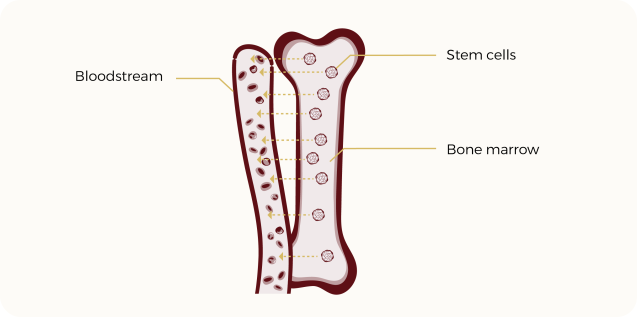
Mobilization Medicine
One or more medicines are used to move stem cells from the bone marrow into the bloodstream so they can be collected.
(Stem cells → bloodstream → bone marrow)
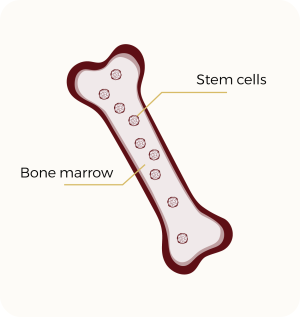
Conditioning Medicine (Chemotherapy):
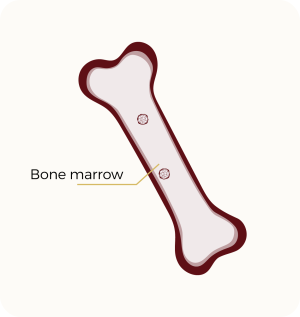
This is used to make space in the bone marrow for the new blood cells before you receive the therapeutic infusion.
Before
(Bone marrow → stem cells)
After
(Bone marrow)
If you are of childbearing potential, a pregnancy test will be performed prior to the administration of mobilization agents and chemotherapy, to confirm that you are not pregnant. In the event that you become pregnant, or suspect pregnancy after initiation of treatment, you must notify your healthcare team immediately.
Pregnancy
This treatment must not be administered during pregnancy due to the potential adverse effects of chemotherapy. The effects of Casgevy on pregnant individuals are unknown.
If you are planning to become pregnant, or considering pregnancy after receiving treatment, you should consult your healthcare team for support and guidance.
Contraception for Males and Females
An effective method of contraception must be used starting from mobilization in Step 2 and continuing for at least 6 months following the administration of Casgevy, if you can become pregnant or able to father a child.
Please discuss with your healthcare team the most appropriate methods of contraception for your situation.
Breastfeeding
Breastfeeding must be discontinued during chemotherapy due to potential adverse effects.
It is not known whether components of Casgevy can be excreted in breast milk. Your healthcare team will evaluate the benefits of breastfeeding for your infant against the potential risks of treatment.
Fertility in Males and Females
Chemotherapy may affect your fertility. It is important to discuss your options, including fertility preservation, with your healthcare team prior to treatment. This may involve the cryopreservation of reproductive material (such as sperm or oocytes) for potential future use.
Low platelet and white blood cell levels after treatment
After Casgevy treatment, your blood cell levels will be low for a period until the modified cells settle in the bone marrow.
This includes low platelet levels, which normally help with blood clotting. Low platelets may cause bleeding.
Driving and Operating Machines
Medicines used in stem cell mobilization and chemotherapy may cause dizziness or fatigue.
If you feel dizzy, tired, or unwell, do not drive, operate machinery, or engage in activities that require alertness (e.g.) weight lifting.
Consult your healthcare team for support and advice.
Tell your healthcare team immediately if you notice signs of low platelet levels such as:
- Severe headache
- Unusual bruising
Persistent bleeding/bleeding without injury, such as nosebleeds, gum bleeding, blood in urine, stool, vomit, or coughing up blood.
White blood cell levels may also be low, which increases the chance of infection.
Notify your healthcare team immediately if you develop fever, chills, or signs of infection (such as sore throat, cough, shortness of breath, painful or burning urination, frequent urination, or diarrhea).
Your healthcare team will monitor your blood cell counts and provide treatment as clinically indicated, and they will inform you once your blood counts have returned to safe levels.
You must not receive Casgevy if you are allergic to:
- Any of the ingredients in this medicine, including Dimethyl Sulfoxide (DMSO), Dextran 40, or Cas9, due to the risk of severe allergic reactions.
- Any ingredients in the medicines used to prepare you for therapy, including mobilization and chemotherapy medicines (Steps 2 and 4 of the treatment journey).
If you are unsure whether you are allergic to any of these ingredients, or if you have never been exposed to them, inform your healthcare team. They will monitor you carefully for allergic reactions during or after treatment.
You must not donate blood, organs, tissues, or cells.
Your healthcare team will continue monitoring your blood levels and overall health after treatment.
As this will help your medical team to understand the long term complications of the treatment .
There is a theoretical risk of developing blood cancers (such as myelodysplastic syndrome, leukemia, or lymphoma) related to the gene editing process, though this has not been observed in Casgevy studies. Your healthcare team will monitor you at least once a year for 15 years.
Because Casgevy is made from your own cells, Bahrain Oncology centre must keep certain information for 30 years, including your name, the therapy name, and the batch number(s) you received.
Every person is different, and there is a chance the treatment may not be completed.
If Casgevy cannot be given after chemotherapy (conditioning medicine), or if the modified stem cells fail to establish in the body, your healthcare team may return your original (backup) stem cells collected in Step 2.
If you receive your backup cells, you will not benefit from the therapy and will still need treatment for sickle cell disease or beta thalassemia that requires blood transfusions.
step 1

Preparing to Collect Your Stem Cells
(Red blood cell transfusions) or cell Exchange

Minimum duration:
approximately 8 weeks
step 2

Collecting Your Stem Cells
(Mobilization and apheresis)

Approximately 1 week per collection cycle 1 or more cycles (if required), repeated over a period of 6–8 weeks
step 3

Waiting for Your Genetically Modified Cells
(Treatment, manufacturing, and quality testing
Up to 6 months
step 4

Receiving Your Treatment — including conditioning (chemotherapy) and recovery
(Conditioning, infusion, and stabilization)
Conditioning:
approximately 2–6 days
Infusion:
over several hours
Stabilization and recovery:
approximately 6-8 weeks
step 5

Adjusting to Life After Treatment
(Follow-up and supportive care)
Ongoing, as determined by your healthcare team
Step 1
Preparing to collect your blood stem cells
During this step, you will undergo simple or exchange blood transfusions to prepare your body for collecting blood stem cells.
Step 2
Collecting your blood stem cells
You will take medicines during this step to mobilize your stem cells into the bloodstream so they can be collected. Afterwards, your blood stem cells will be collected and sent to the manufacturing site. This step may need to be repeated more than once.
Step 3
Waiting for your genetically modified cells
Your stem cells arrive at the manufacturing site for gene editing and quality testing. During this time, you will be at home preparing for the next step of treatment and undergoing fertility-preservation procedures (if relevant) .
Step 4
Receiving treatment, including conditioning (chemotherapy) and recovery
In this step, you will first receive chemotherapy (conditioning medicine) to make room in the bone marrow for the newly edited cells to grow. Then, Casgevy cells—made from your own stem cells—will be infused, and you will spend about one to two months recovering at the Bahrain Oncology center, although this period can vary.
Step 5
Adjusting to life after treatment
Once you return home, your healthcare team will continue to monitor your progress and health.
What you need to know about side effects
Like all medicines, Casgevy may cause some side effects; however, this does not necessarily mean all patients will experience them. Some are related to the mobilization medicines and chemotherapy (conditioning medicines). You should also read the package leaflets for those medicines. You can find more information about the medicines used and the potential side effects in the patient leaflet, or you can discuss with your medical team .
Serious side effects
There are some serious side effects that can occur during the first days or weeks after treatment, but they can also develop later. You must inform your healthcare team immediately if you experience:
Pain in the upper right part of the abdomen under the ribs, yellowing of the eyes or skin, rapid weight gain, swelling in the arms, legs, and abdomen, and difficulty breathing. These may be signs of a serious liver condition called veno-occlusive disease.
Severe headache, unusual bruising, prolonged bleeding, or bleeding without injury, such as nosebleeds, bleeding from the gums, blood in the urine, stool, or vomit, or coughing up blood. These may be signs of thrombocytopenia (low platelet levels), which reduces the blood’s ability to clot and may lead to bleeding.
Fever, chills, or infections (signs include sore throat, cough or shortness of breath, pain or burning when urinating or frequent urination, or diarrhea). These may be signs of neutropenia, which is a low level of white blood cells called neutrophils that fight infections.
Very common side effects for medication
Very common side effects that may affect more than 1 in 10 people:
Nausea
Headache
Vomiting
Muscle or bone pain
Abdominal pain
Uncommon side effects
A lung condition presenting with sudden symptoms such as sharp chest pain, fever, difficulty breathing, and signs of fluid accumulation in the lungs on chest imaging; this occurs in sickle cell disease (acute chest syndrome).
Painful crisis of sickle cell disease (sickle cell anemia with crisis).
Pain.
Elevated white blood cell count.
Diarrhea.
Mouth and throat pain.
Numbness in the mouth.
Joint pain.
Generalized pain
Feeling tired.
Low potassium levels in the blood (hypokalemia).
Low magnesium levels in the blood (hypomagnesemia).
High phosphate levels in the blood (hyperphosphatemia).
Very common side effects
Very common side effects that may affect more than 1 in 10 people:
Nausea
Headache
Vomiting
Abdominal pain
Fever during a period of low neutrophils (a type of white blood cell) (febrile neutropenia)
Low red blood cell levels (anemia)
(lymphopenia)
Low potassium levels in the blood (hypokalemia)
High phosphate levels in the blood (hyperphosphatemia)
Low magnesium levels in the blood (hypomagnesemia)
Low phosphate levels in the blood (hypophosphatemia)
Fluid retention in the body
Nosebleed (epistaxis)
Inflammation of the stomach lining (gastritis)
Constipation
Diarrhea
Mouth and throat pain
Inflammation of mucous membranes, such as the gums (mucositis)
Loss of appetite
Weight loss
Muscle or bone pain
Dry skin
Peeling skin
Change in skin and nail color
Small pinpoint spots of blood under the skin (petechiae)
Rash
Hair loss (alopecia)
Increased bilirubin levels in the blood, a breakdown product of red blood cells, which may cause yellowing of the skin and eyes (elevated blood bilirubin)
Increased level of a liver enzyme (alanine aminotransferase)
Uncommon side effects
A cluster of pneumonia-like symptoms, such as fever, chills, cough, and breathing problems, occurring without evidence of lung infection (idiopathic pneumonia syndrome)
Inability of the lungs to deliver oxygen to your blood (respiratory failure)
Shortness of breath
Infection in the blood (sepsis)
Inflammation in the lung (pneumonia)
Fungal infection in the mouth (oral candidiasis)
Inflammation of hair follicles
Increased heart rate (tachycardia)
Low blood pressure (hypotension)
Low oxygen levels in the blood (hypoxemia)
Enlarged liver (hepatomegaly)
Enlarged spleen (splenomegaly)
Nerve damage in the arms and/or legs causing pain or tingling, burning and tingling (peripheral neuritis)
Problems with the sense of taste (dysgeusia)
Blurred vision
Dry eyes
Hot flushes
Cough
Indigestion (dyspepsia)
A disease where stomach acid rises into the esophagus or food pipe (gastroesophageal reflux disease)
Bleeding from the gums (gingival bleeding)
Inflammation of the large intestine causing pain and diarrhea (colitis)
Inflammation of the esophagus (esophagitis)
Blood in vomit (hematemesis)
Bleeding from the rectum (rectal hemorrhage)
Mouth ulcer
Pain when urinating (dysuria)
Blood in the urine (hematuria)
Absence of menstrual periods (amenorrhea)
Irregular menstrual cycles
Pain in the vagina and labia
Early menopause
Weight gain
Itching (pruritus)
Redness of the skin (erythema)
Low levels of all types of blood cells (pancytopenia)
Abnormal accumulation of fluid surrounding the brain and spinal cord (hydrocephalus)
Joint pain (arthralgia)
Longer time to the start of engraftment and production of normal blood cells (delayed engraftment)
Contact Form
We’re here to assist you with your inquiries.